A living project · Pilot hub active in Ecuador

Maybe it isn't you maybe it is the way we live.

EcoHubs is a growing network of people building a different way to live together — rooted in nature, honest about conflict, and designed so that belonging is built in, not left to chance.

Permaculturists, community builders, systems thinkers and seekers of a different kind of life — co-creating this, one pilot at a time.
Community working together
Quiet moment in nature
Community group
Community blueprint
Stories behind this project

Every project begins with a feeling.
This one is carried by many.

EcoHubs didn't come from a single person with a plan — it came from many people, in different corners of the world, who quietly felt the similar things. Read their stories.

01 · Feeling alien

Growing up in Germany, I felt alien. Lonely. I didn't understand why then—but the feeling was strong, and I listened to it instead of suppressing it.

For a long time I thought something was wrong with me. Eventually another thought arrived: maybe it isn't me. Maybe it's the way we live.
02 · Leaving, and listening

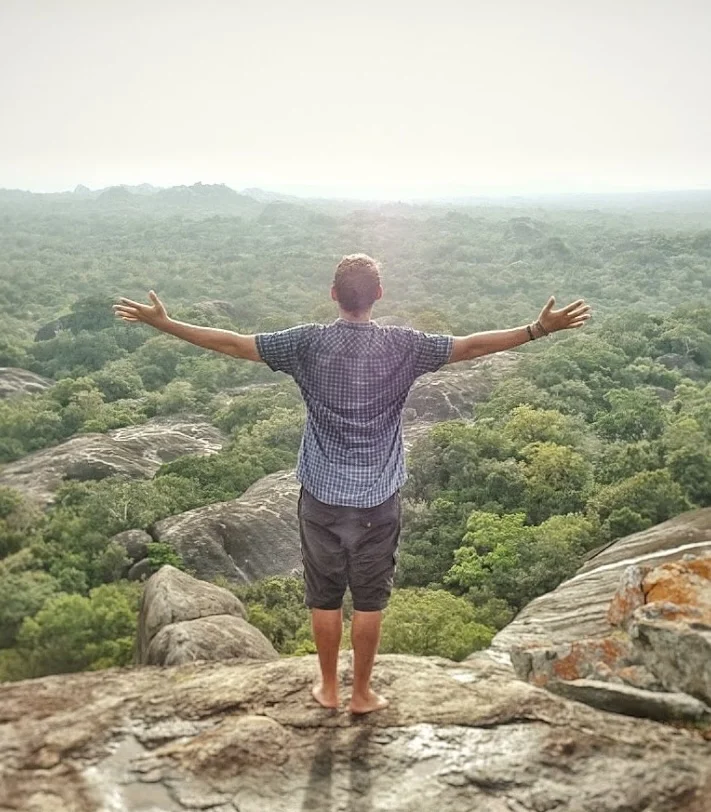
So I left. I traveled for many years, and for the first time I had space to actually hear myself. I connected to nature. I connected to other people who also felt alien in their previous lives.

And for the first time — I didn't feel lonely. I felt connected to myself. I felt alive.

03 · Finding others who felt it too
"

I learned so much about different ways of living — permaculture, alternative education, meaningful work, new ways of making decisions. Alternatives that actually work, that are a lot better. And I kept asking: why don't we use them?

04 · Why I stopped trying to change the system

I had endless ideas for applying these alternatives inside the big system we live in. Over time I learned it's almost impossible. The system is too rigid. Too big to bend.

This is where I think most institutions fail when they try to make an impact. They put band-aids on wounds. They don't heal the wound — because the system doesn't allow the wound to be healed.

So I changed my question. Not how do I fix this system?, but how do I build a new way of life inside it? That's when I found my answer in intentional communities — small, place-based groups already living many of the alternatives I'd spent years studying.

05 · The guidebook I wished had existed

That's how EcoHubs began. Not as a product. As a direction.

Intentional communities held everything I was looking for — and yet some sources claim that 80–90% of them fail. Not because the vision is wrong. Because we were never taught how to live this close together — how to make decisions, resolve conflict, make the invisible things explicit.

So I wrote the guidebook I wished someone had handed me. It is not an ideology. It is a handful of patterns that say: make this explicit. Talk about this before it breaks. This is what's usually left unsaid. We call it the RCOS Blueprint.

— Stefan

If Stefan's story sounded familiar

It's not just you.
It's the system we all grew up inside.

What most of us live with wasn't designed for humans. It was designed for output, for growth, for scale. These are some of the wounds it leaves.

Belonging

The loneliness no one names

We've never been so connected and so alone. Neighbors we never meet. Hours of scrolling instead of one shared meal.

Earth

We are taking more than the land can give

Extractive agriculture strips the soil. Short-term profit costs the biosphere its long-term life. The math stopped working a while ago.

Economy

Globalization hollowed out the local

Power concentrates at the top. Towns lose their shops, their culture, their self-sufficiency. Energy is burned just to ship our food around the world.

Work

Eight hours a day to survive

Most work is abstract and far from home. You never see who it served. A lifetime of effort and still the question: what was all that for?

There are 4 more wounds — we didn't list every one. The pattern is what matters.

Our stance

The system does not provide —
nature does.

Power is a human construct.
It only works as long as we consent to it.

We are not waiting for permission from a system that cannot heal itself. We are quietly building a different way of life inside it — one that needs it less, and less, and less.

What changes in a regenerative community

Most of these wounds dissolve
when the scale gets small again.

Not because community is a cure, but because most of our pain comes from living at a scale humans were never built for. Bring the scale back down — to a place, to people you know by name — and the knots start to loosen on their own.

Belonging

Neighbors who know your name

In a small place, you are seen. You are missed when you are gone. Belonging isn't an achievement — it's the air you breathe.

Work

Work that lands in someone's hands

When the person you serve is across the table, not across the planet, work stops being a shift you survive and starts being something that means something.

Earth

Land cared for by the people who live on it

Permaculture, regenerative agriculture, local food. Soil is built, not mined. Water is read, not piped. Nature isn't a backdrop — it's the other half of the community.

Economy

Local first, resilient by design

Small businesses serving the people around them. Less dependency on fragile global chains. Less waste shipped. More value staying where it's made.

There are 6 more shifts — we didn't list every one. The pattern is what matters.

A network, not an escape

One community is a refuge.
A network of them is an answer.

An EcoHub on its own is a beautiful project. But the vision is bigger: an interconnected network of small, locally rooted communities that share what they learn and strengthen each other.

We are not trying to replace the system with a revolution. We are quietly reducing our dependency on it — community by community — until a different way of life becomes normal, accessible, and replicable.

Local

Rooted in a place, adapted to its culture and climate.

Connected

Sharing patterns, failures, and tools through the Blueprint.

Replicable

Forkable. Not franchised. Every hub stays its own place.

Not waiting · already underway

What we are already doing
— quietly, in the open.

EcoHubs is not a future plan waiting for funding. Five strands of work are underway right now. Each one feeds the others, and each one is documented as we go.

01 Practice

Applying the RCOS Blueprint to our own community.

We are the first test of the Blueprint. Membership, governance, conflict, and decision pathways are written down and used by us, on us — refined as the community grows.

Read our RCOS specs ↗
02 Pilot

FruitHaven Community RCOS pilot.

In Ecuador, an existing community has been applying the Blueprint since March 2026 — under real ecological, social and economic constraints. Lessons feed straight back into the standard.

See the pilot →
03 Research

Studying what works (and what breaks) in intentional communities.

We read the literature, talk to elders of past projects, and document the failure patterns that keep coming back. The Blueprint earns its place by surviving those patterns — not by ignoring them.

Open the research →
04 Design

New ways to make community more accessible & replicable.

Lower the bar to entry. Make adoption modular. Make resilience the default. We are designing the patterns, tools, and onboarding paths that turn intentional community from rare into normal.

See where we need help →
05 Community

Growing the online community — members, events, partnerships.

Weekly calls, member onboarding, partner conversations, public events. The network gets stronger every time someone shows up — and every relationship made here is a thread that holds.

Become a member →
+ Open work

Pick a strand. Bring a hand.

All five strands are open. Pick the one that matches your craft — the work moves faster when more people show up.

Join the work →
Regenerative community network
Shared meal
The Vision

Small places
where your work, your home,
and the people you love

are in the same story.

An EcoHub is a small, place-based community where people live, work, and learn together while regenerating the land they depend on. Human-scale. Locally rooted. Connected to a wider network of others doing the same.

Not a utopia. Not an escape. A working model for belonging, tested in real conditions and shared openly so others don't have to start from zero.

  • Work that means something because it shows up in your neighbors' lives
  • Decisions made in the open, by the people they affect
  • Land and resources held in care, not in competition
  • Conflict treated as information, not as failure
The Blueprint · RCOS

The guidebook we wished
had existed.

The Blueprint — formally RCOS (Regenerative Community Operating System) — is an open standard for designing and operating regenerative communities. Not software. Not an ideology. A shared way to make community structure explicit, testable, and improvable.

It's the first tangible outcome of EcoHubs — and the bridge between the vision and the ground. Anyone can pick it up, read it, fork it, and put it to work today.

Open standard Modular & forkable Tested in a live pilot
RCOS · v0.1 · public draft
layer 0 · purpose & scope
layer 1 · membership
layer 2 · governance
layer 3 · economy & resources
layer 4 · conflict & repair
layer 5 · operations
layer 6 · evolution
— optional —
module · permaculture
module · education
module · housing
Open · Forkable · Adaptable See all seven layers →
The people behind this

EcoHubs is not a product.
It's the people showing up.

Each circle is a real member — contributing their craft, their voice, their time. The larger ones carry the most weight right now. Click any one to read their story.

Active
10
Active members
4
Countries
6
Languages
1.7k
XP co-created
On the technology behind this

Tech serves life.
Not the other way around.

People sometimes ask: how can you use AI and digital platforms while building something regenerative? It's a fair question. Our answer is honest — we use technology where it lets one person do the work of ten, where it bridges distance, where it lets a community remember what it said.

We don't use it to manufacture engagement, replace relationships, or grow at any cost.

Don't cede the tools

AI is being shaped, right now, by people who use it to extract — to concentrate attention, capital, and decisions in fewer and fewer hands. If those of us building something different sit this out, the future gets written without us. We pick up the same tools, deliberately, while there is still time to point them somewhere else.

Spend now, save more later

Yes, AI costs energy and water — we don't pretend otherwise. We treat it as an upfront investment, the way you build soil. Compute spent now to design regenerative systems returns many times over: in trips not taken, in food grown closer to home, in mistakes a hundred communities don't have to make twice.

Change what the tools optimise for

A tool isn't good or bad — its metric is. Extractive AI is tuned for profit per resource: more clicks, more attention, more dollars wrung from the same earth. We use the same engines, pointed at a different target — life per resource. Same code, opposite direction.

Move at the speed of the crisis

Extraction is digital, fast, and well-funded. Regeneration is too often analog and slow — and it has been losing ground for decades. To rebuild on the same scale we have been losing on, we have to work at that pace. Patience in the soil, yes. Patience in the response, no.

Who this is for

If you've been quietly looking for this,
you're in the right place.

"I felt alien too."

People who knew early that the default life wasn't the only life — and who have been searching since.

"I've tried to build a community and it broke."

Organizers and founders who've seen well-meaning projects collapse, and want to understand why.

"I work with land."

Permaculturists, farmers, stewards — who know the soil is ready, and the humans are the harder part.

"I build tools for people."

Designers, developers, facilitators who want their craft to land somewhere that actually matters.

"I want meaningful work."

People whose work feels abstract, far from home, and who want it to feed the people they live near.

"I'm just tired of doing this alone."

Which is, honestly, a lot of us. That's enough of a reason to show up.

If even one of those felt like it could be your voice — we'd love to meet you.

Become a member

Application is free · we read every one

Questions we hear a lot

Honest answers to the honest questions.

What is EcoHubs? +
EcoHubs is a growing network of people building an open-source blueprint for regenerative communities — a way of life that puts belonging, ecology, and shared decision-making back at the centre. It is online today and place-based tomorrow, with the first physical pilot already running in Ecuador.
What is the Blueprint (RCOS)? +
RCOS — Regenerative Community Operating System — is the open standard at the heart of EcoHubs. It writes down the things communities usually leave unsaid: how decisions get made, how people join and leave, how resources are managed, how conflict is repaired. Not an ideology. A shared language.
Is EcoHubs a real project, or just a vision? +
Real. The blueprint is being written, the community is active, and the first blueprint pilot is running in Ecuador. The project is structured in phases — community formation → blueprint development → pilot hubs — and we're in all three at once.
How is this different from existing ecovillages or intentional communities? +
Three things. First, the blueprint is open-source — most communities run on undocumented systems; we write ours down so it can be replicated and improved. Second, it integrates ecology, governance, economy and culture as one design, not separate departments. Third, there is a digital coordination layer so dozens of communities can learn from each other instead of each starting from zero.
Is the goal to replace existing society, or to build an alternative within it? +
An alternative within it. We're not building a wall against the world. We're building small, working examples of a different way to live — and connecting them, so anyone who wants in has a real path.
How do people earn a living in an EcoHubs community? +
Most members keep their existing income — remote work, services, freelance — and gradually shift toward local production and contribution-based work as the community matures. There's no purity test. The model is hybrid by design: external income today, more circular and local over time.
Roadmap

One step at a time, in the open.

01

Gather the people

First 150 aligned members. Shared values. Foundation of the Blueprint co-created, not dictated.

02

Grow the Blueprint

Open-source, evolving — shaped by practice across ecology, governance, economy, culture, and care.

03

Pilot, learn, share

Apply the Blueprint in real communities. Ecuador is the first. Document every scar, every win, openly.

Before you join — a different invitation

We are not finished.
That is the point.

EcoHubs is not a product you sign up to. It's a Blueprint that gets better with every person who reads it carefully, disagrees with a chapter, runs an experiment, comes back with what they learned. There are many ways in.

None of these are tiers. None of these cost. They are the doorways we have noticed people walk through.

An invitation

If any part of this
sounded like your life
come build it with us.

We're not looking for believers. We're looking for people who are ready to make the invisible things explicit — in their own lives, and with others.

Non-speculative · Non-ideological · Built in the open

Stay close to the work

Letters from a young project.
Rare, but real.

We're early — a small project finding its shape. When something actually shifts — a new chapter of the Blueprint, a note from the Ecuador pilot, an invitation to gather — we'll write. No schedule. No filler.

RSS Feed
EcoHubs
EcoHubs Communitiy

We are co-creating the blueprint for regenerative living. Join us to design communities that thrive in harmony with nature.

DiscordMastodonFarcasterXInstagramLinkedInGitHub
© 2026 EcoHubs.community · Built in the open, with care and regenerative principles.